Mobile Proxies for Web Scraping: How to Collect Data Without IP Bans
Most major websites actively fight back against scrapers. This guide explains why mobile proxies outperform other proxy types on heavily protected targets, and how to configure rotating and sticky sessions for different scraping workflows.

Web scraping has become one of the most important methods for collecting data at scale. From tracking competitor pricing to training AI models and verifying ads, businesses across every sector rely on automated data collection to stay informed and competitive.
The challenge is that most major websites actively fight back. Anti-bot systems from providers like Cloudflare, Akamai, and DataDome analyze IP reputation, request patterns, and browser behavior in combination. Getting flagged on any of these layers is often enough to trigger a block, a CAPTCHA, or a silent redirect to an empty page.
This guide focuses on one specific question: why do mobile proxies tend to outperform other proxy types on heavily protected scraping targets, and how should you use them in practice.
How Anti-Bot Systems Detect Scrapers
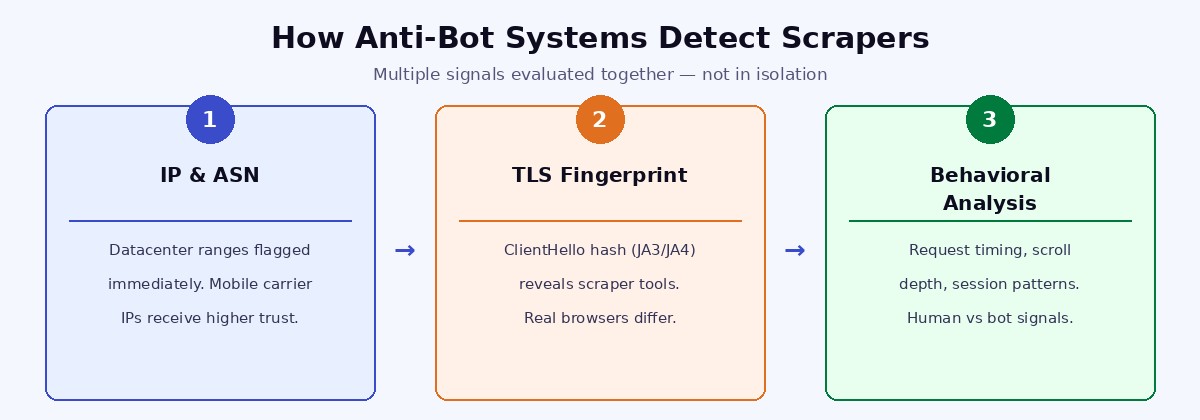
Anti-bot systems often begin evaluating traffic at the connection level, before any page content is exchanged, though detection can also happen adaptively throughout a request flow, particularly in login or checkout sequences. Multiple signals are assessed together rather than in isolation.
IP Reputation and ASN Detection
Every IP address belongs to an Autonomous System Number (ASN). IP ranges from well-known datacenter providers like AWS, Google Cloud, and Azure are widely documented and tend to receive lower trust scores on sites that use commercial bot management. The response varies by platform: some apply hard blocks on datacenter ASNs, while others use scoring systems that weigh IP type alongside other signals before making a decision.
TLS Fingerprinting
During every HTTPS connection, the client broadcasts its supported cipher suites and extensions in a ClientHello message. This combination can be hashed into a fingerprint, commonly known as a JA3 or JA4 hash. Python's requests library produces a fingerprint that differs from any real browser. Detection systems treat this as a risk signal, typically one factor among several rather than a standalone trigger for blocking.
Behavioral Analysis
Systems like PerimeterX and DataDome track patterns across a full session: request timing, navigation depth, scroll behavior, and interaction patterns. Behavioral analysis carries particular weight in flows that involve authentication or multi-step sequences, where the expectation of human-like continuity is higher.
Key point: Detection systems evaluate multiple signals together, not in isolation. IP type is one of the strongest early signals, but behavioral patterns and browser fingerprints contribute throughout the request flow, especially on more sophisticated platforms.
Why Mobile Proxies Tend to Perform Better on Protected Targets
Mobile proxies route traffic through real SIM cards on 4G and 5G carrier networks. The IP addresses they produce are assigned by operators like Vodafone, T-Mobile, or AT&T as part of their live cellular infrastructure.
Mobile carrier networks use Carrier-Grade NAT (CGNAT), which routes many real subscribers through the same shared public IP simultaneously. Because a single mobile carrier IP is shared by a large number of genuine users, aggressively blocking that IP carries a higher risk of collateral damage to legitimate traffic. This makes platforms more cautious about applying hard blocks to mobile carrier IPs, and generally results in higher trust scores for this IP type.
Important distinction: Higher trust scores do not mean mobile proxies are immune to detection or blocking. If a mobile IP exhibits clear abuse patterns, rate limits and blocks still apply. The advantage is that mobile carrier IPs start from a more favorable baseline, and aggressive blocking of carrier ranges is less common because of the collateral risk to real users.
What This Means for Scraping
On heavily protected targets, the trust score difference between proxy types translates into a meaningful difference in success rates. Datacenter IPs carry the most risk because their origin is immediately identifiable. Residential ISP IPs perform better, but shared pools can carry reputation from previous users. Mobile carrier IPs benefit from the CGNAT baseline, though their performance still depends on the specific target, request patterns, and provider quality.
For most standard scraping tasks on moderately protected sites, residential proxies offer a reasonable balance of cost and performance. Mobile proxies are most useful for the subset of targets where residential proxies produce consistently poor results.
Choosing the Right Proxy Type for Your Scraping Task
The right proxy type depends on the target's actual protection level. Mobile proxies cost more per GB than the alternatives, and using them where simpler options work reliably adds cost without proportional benefit.
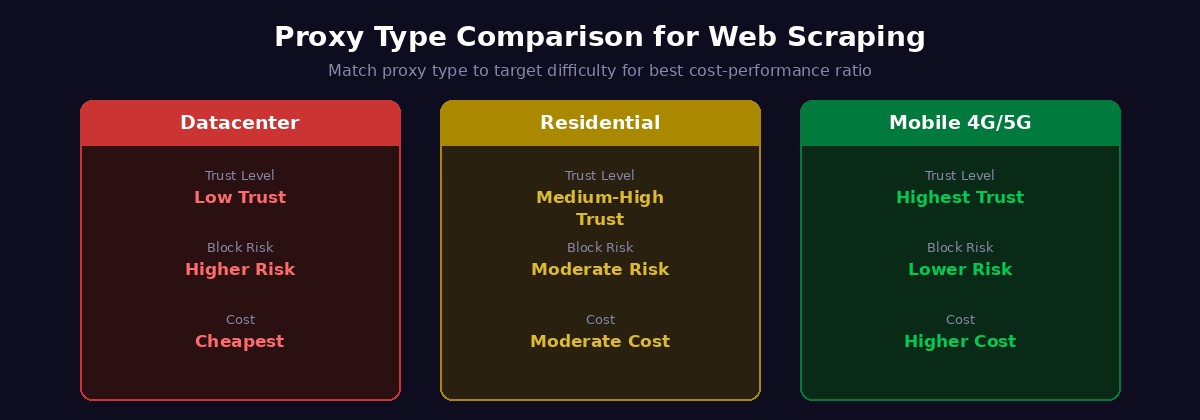
A practical approach is to tier proxy usage by target difficulty: start with the cheapest type that produces reliable results, and escalate to mobile proxies only where other options consistently fail.
Where Mobile Proxies Add Real Value in Scraping
The following use cases represent targets where the combination of strong anti-bot protection and mobile-specific traffic expectations tends to make mobile proxies a better fit than alternatives.
E-Commerce Price Monitoring
Major retail platforms run active bot detection partly because they have a direct financial interest in protecting their pricing data. Residential proxies handle a broad range of retail sites reasonably well, but the largest platforms with the most sophisticated detection tend to produce better results with mobile-grade IPs. Geo-targeted mobile proxies also allow you to collect pricing data that reflects what a real customer in a specific city or region would see.
SERP and SEO Monitoring
Search engines track scraping activity and can return altered results or throttle requests from addresses with accumulated signals. Mobile proxies with proper rotation reduce the risk of session-level fingerprinting, and carrier-level geo-targeting allows you to check localized results that reflect the actual search experience in a given market.
Ad Verification
Ad verification involves checking that ads display correctly across different geographic locations and device types. Requests that appear to originate from real mobile users in real locations more closely mirror how genuine end users would see an ad, making mobile proxies a practical choice where accuracy of the simulated environment matters.
Social Media Data Collection
Social platforms deploy some of the most layered detection systems, combining IP scoring, session behavior, and device fingerprinting. They also see the overwhelming majority of their real traffic from mobile devices, which means mobile carrier IPs match the expected traffic profile more closely than other proxy types.
AI and Machine Learning Data Pipelines
Large-scale data collection for AI training often spans many sources, some of which are aggressively protected. Mobile proxies reduce the frequency of blocks and CAPTCHAs on the harder targets. For less protected sources within the same pipeline, residential or datacenter proxies may be more cost-efficient.
Rotating vs Sticky Sessions for Scraping
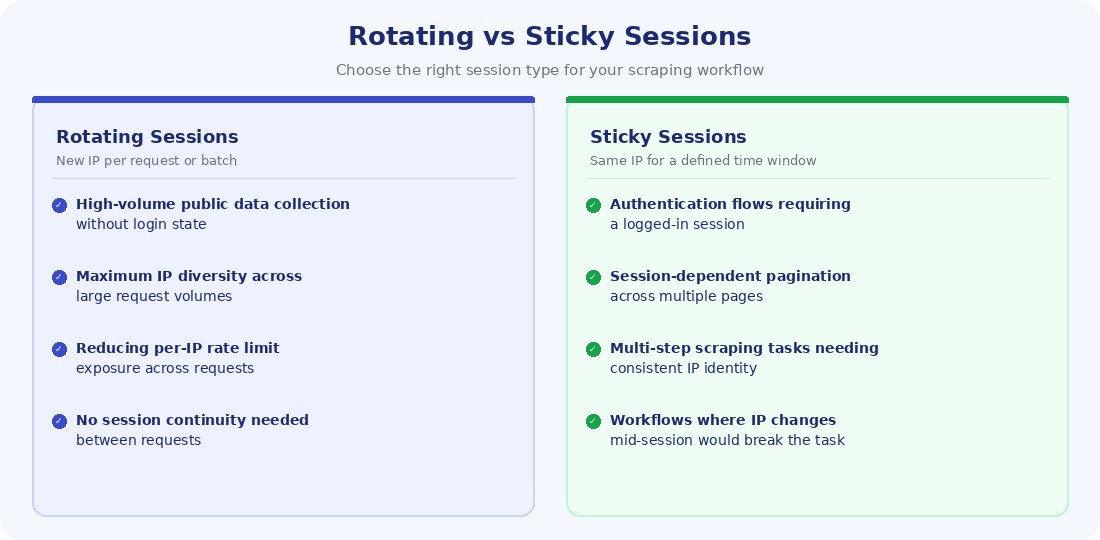
Session configuration is as important as proxy type. The choice between rotating and sticky sessions depends on whether the task requires continuity across requests.
Rotating Sessions
With rotating sessions, each request or small batch of requests is routed through a different IP. This is the standard configuration for large-scale collection of public data, where the goal is throughput and no session state needs to be maintained between requests. Distributing traffic across many IPs reduces the per-IP request count, which is one of the more straightforward signals that rate limiting systems act on.
Sticky Sessions
Sticky sessions maintain the same IP for a defined period, typically ranging from a few minutes to several hours. Any scraping task that involves authentication, session-dependent pagination, or multi-step flows requires sticky sessions. If the target site expects a consistent IP across a sequence of requests and detects a change mid-session, it will typically trigger a security response.
Practical guidance: Use rotating sessions for public data at scale where no session state is required. Use sticky sessions for any workflow that involves authentication or expects consistent IP behavior across multiple requests. Most mobile proxy providers support both configurations, switchable per connection or via API.
Summary
Mobile proxies perform better on heavily protected scraping targets primarily because mobile carrier IPs benefit from a higher trust baseline across detection systems, and because the CGNAT architecture makes aggressive blocking of carrier IP ranges more costly for platforms. They are not immune to detection, and their advantage depends on the specific target, request patterns, and provider quality.
The practical approach is to match proxy type to target difficulty. Rotating sessions work well for high-volume public data collection. Sticky sessions are necessary for any workflow involving authentication or session continuity. Mobile proxies are most justified on the targets where residential options consistently underperform.
For e-commerce monitoring, social media data collection, SERP tracking, ad verification, and AI data pipelines on well-protected targets, mobile proxies reduce the friction that limits other proxy types at scale. They are a specialized tool for difficult targets, and that is precisely where they earn their cost.
Start Scraping Without IP Bans
Power Proxy gives you real 4G and 5G mobile IPs with rotating and sticky session support, geo-targeting, HTTP, SOCKS5, and OpenVPN protocols, and dedicated hardware. No shared bandwidth.
Narmin Kamilsoy
Contributing author sharing insights and stories on our blog.