Mobile Proxies for Dutch E-commerce: Price Monitoring and Research
A practical guide to mobile proxies for Dutch e-commerce: why Dutch platform data varies by location, how carrier IPs support price monitoring on bol.com, Coolblue, Amazon.nl, Marktplaats, and Zalando NL, iDEAL | Wero checkout testing, Dutch locale configuration, rotating vs sticky session setup, common mistakes, and GDPR compliance for Dutch market data collection.

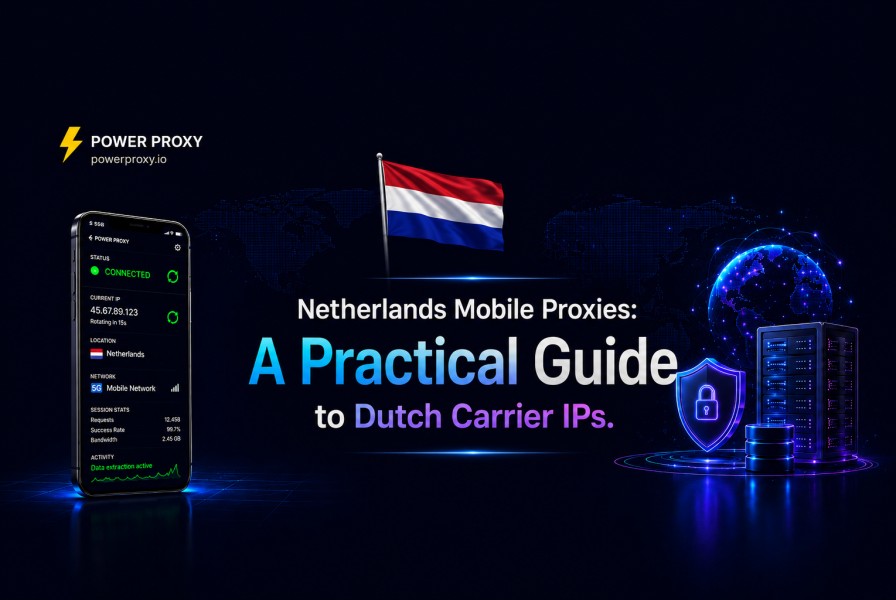
Dutch e-commerce is one of the most location-sensitive markets in Europe. bol.com, Coolblue, Amazon.nl, Marktplaats, and Zalando.nl can adapt parts of the shopping experience according to the visitor's location and other contextual signals. A request from a foreign IP may return different prices, promotions, availability, delivery options, or checkout experiences than a request coming from the Netherlands.
For businesses that need accurate Dutch market data, whether for competitive price intelligence, product availability research, regional storefront testing, or QA validation, the network layer matters. This guide covers how mobile proxies with Dutch carrier IPs support each of these workflows, platform by platform.
Why Dutch E-commerce Data Can Vary by Location
Localized Pricing and Promotions
Major Dutch retailers can localize prices, discount codes, promotional banners, and loyalty offers based on the visitor's apparent location. A request from a foreign IP may return different prices, miss Dutch-specific promotions, or be redirected to a non-Dutch version of the product page. Dutch platforms may apply market-specific pricing that differs from what the same retailer shows in neighboring markets, even for the same product.
For price monitoring workflows that need to track what Dutch consumers actually see, a Dutch carrier IP can help ensure the response reflects the locally-served content. For more on how Dutch carrier IPs work, see Netherlands Mobile Proxies.
Dutch Payment Method Context
iDEAL has been the dominant online payment method in the Netherlands. In 2026, iDEAL is transitioning to iDEAL | Wero as part of a phased migration to the pan-European Wero payment system, with full migration targeted by end of 2027. Dutch storefronts continue to present iDEAL | Wero as a primary bank-based payment option throughout this transition.
A request from a foreign IP may see a different set of payment options or a checkout experience configured for international visitors. For checkout flow testing and QA validation, a Dutch carrier IP can help reproduce the payment options Dutch consumers encounter. Whether and how iDEAL | Wero appears also depends on merchant configuration and checkout environment.
Delivery Options and Availability
Dutch retailers configure delivery options, estimated arrival times, and stock availability based on the visitor's location. Same-day delivery slots, local pickup options, and fulfillment timelines may differ for Dutch versus non-Dutch visitors. For businesses monitoring inventory and fulfillment options for the Dutch market, requests that carry a Dutch geographic signal can return more locally-accurate results.
Why Mobile Proxies Matter for Dutch E-commerce Research
Many Dutch e-commerce platforms use automated traffic detection and other access controls. Mobile carrier IPs can present a different network profile from datacenter IP ranges because they originate from carrier networks shared among many real subscribers. For a detailed explanation of how carrier-grade NAT works, see What Is CGNAT?
Monitoring competitor prices on bol.com, Coolblue, and Amazon.nl requires requests that return Dutch-localized pricing. For independent requests, rotating sessions can distribute traffic across available Dutch carrier IPs.
Stock levels, fulfillment options, and availability statuses can differ by location on Dutch platforms. A Dutch carrier IP can help ensure availability data reflects what Dutch consumers see.
Understanding how Dutch competitors position products, structure promotions, and configure their storefronts requires access to the Dutch-localized version of those pages.
QA teams validating Dutch storefronts, testing iDEAL | Wero checkout flows, or verifying Dutch-targeted campaigns benefit from a Dutch network environment with Dutch locale headers.
Mobile Proxies for Major Dutch E-commerce Platforms
bol.com
bol.com is one of the largest general e-commerce marketplaces in the Netherlands. The information displayed on bol.com can depend on location, delivery context, account state, and other session signals. For Dutch market research, a Dutch carrier IP can help reproduce a Netherlands-based network context when geographic localization affects the response.
For multi-step workflows such as checking stock and progressing through to checkout, sticky sessions maintain session continuity. For broader catalog monitoring, rotating sessions can distribute requests across available Dutch carrier IPs when consistent with the platform's access rules.
Important: bol.com's terms of service restrict automated data collection. Always verify that your use case is permitted under bol.com's current terms before automating any workflow.
Coolblue
Coolblue is a major Dutch and Belgian electronics retailer with same-day delivery options and localized pricing. It can localize prices, delivery slot availability, and product bundles by location.
When the required information is rendered dynamically, a headless browser routed through a Dutch mobile proxy can provide a more complete view than a basic HTTP request. Coolblue's product pages load stock levels and delivery estimates via JavaScript after the initial page load.
Amazon.nl
Amazon.nl serves Dutch-localized prices, Prime delivery options, and product availability that differ from Amazon.de and Amazon.co.uk. For sellers competing on Amazon.nl or for price intelligence tools tracking the Dutch Amazon marketplace, requests from a Dutch IP can return more accurate Dutch pricing and availability data.
Amazon applies access controls across its marketplace properties. Use request pacing appropriate to the platform and follow Amazon's published access rules.
Marktplaats
Marktplaats is one of the largest classified listing platforms in the Netherlands. For second-hand market research, competitor listing monitoring, or understanding pricing patterns in specific categories, a Dutch IP helps ensure access to the locally-relevant version of the platform.
For legitimate account management workflows on Marktplaats where proxy use is permitted under the platform's terms, a sticky Dutch session maintains a consistent network environment. Always verify proxy use is consistent with Marktplaats's current terms of service.
Zalando NL
Zalando.nl serves Dutch-specific prices, delivery options, and return policies that differ from Zalando.de or Zalando.be. For fashion retail price intelligence or catalog monitoring covering the Dutch market, a Dutch IP returns the locally-accurate version of Zalando's product data.
For independent catalog checks, rotating sessions can be used when consistent with the platform's access rules and the requirements of the monitoring workflow.
Choosing the Right Mobile Proxy Setup for Dutch E-commerce
| Workflow | Session type | Notes |
|---|---|---|
| Price monitoring | Rotating | Each independent request can use a different Dutch carrier IP |
| Checkout and QA testing | Sticky | Maintain session continuity across multi-step flows |
| Regional research | Rotating or sticky | Dutch carrier IP + nl-NL locale headers |
How to Set Up Dutch E-commerce Price Monitoring
Dutch IP and Locale Configuration
import requests

proxies = {
    "http":  "http://user:pass@your-proxy-endpoint",
    "https": "http://user:pass@your-proxy-endpoint",
}

headers = {
    # Mobile User-Agent matches Dutch carrier IP context
    "User-Agent": "Mozilla/5.0 (Linux; Android 14; Pixel 8) AppleWebKit/537.36 (KHTML, like Gecko) Chrome/124.0.0.0 Mobile Safari/537.36",
    "Accept-Language": "nl-NL,nl;q=0.9,en;q=0.8",
    "Accept-Encoding": "gzip, deflate, br",
}

def get_dutch_page(url):
    r = requests.get(url, proxies=proxies, headers=headers, timeout=30)
    return r.text
Replace your-proxy-endpoint with the endpoint shown in your PowerProxy dashboard. Use request pacing appropriate to each target platform and follow its published access rules.
Rotating vs Sticky Sessions
Verifying the Dutch Exit IP
r = requests.get(
    "https://ipinfo.io/json",
    proxies=proxies,
    timeout=30
)
info = r.json()
print(f"Country: {info.get('country')}")
print(f"Org:     {info.get('org')}")
The response should show country: NL. The organization field may identify the Dutch mobile network or network operator. If it shows a hosting or datacenter provider, the proxy is not routing through a carrier IP. Replace your-proxy-endpoint with the endpoint shown in your PowerProxy dashboard.
Dutch E-commerce SERP and Market Research
Google.nl SERP Tracking
Google search results can vary based on location, language, device, personalization, and other contextual signals. A Dutch mobile carrier IP combined with a mobile User-Agent and nl-NL Accept-Language header can produce SERP results that more closely reflect what Dutch mobile consumers see. For more on SERP proxy workflows, see Mobile Proxies for SEO and SERP Tracking.
Ad Verification
Verifying that Dutch-targeted advertising campaigns appear correctly requires requests from within the Netherlands that carry a Dutch device and locale context. Sticky sessions are appropriate for multi-step ad verification flows from impression through to landing page. For broader Dutch market research workflows, see Mobile Proxies for Market Research.
Common Mistakes in Dutch E-commerce Proxy Workflows
GDPR and Platform Terms
Frequently Asked Questions
Dutch Carrier IPs for Dutch E-commerce Workflows
PowerProxy provides mobile proxies in the Netherlands on the Odido (T-Mobile) network, with rotating and sticky session support, HTTP, SOCKS5, and OpenVPN compatibility. Dutch carrier IPs for price monitoring, availability research, checkout testing, and market research on bol.com, Coolblue, Marktplaats, Amazon.nl, and Zalando NL.
Narmin Kamilsoy
Contributing author sharing insights and stories on our blog.