Mobile Proxies vs Residential
Both residential and mobile proxies use real IPs. But when it comes to social media, anti-bot systems, and account management, they are not equal. This guide breaks down the key differences and tells you which one fits your use case.

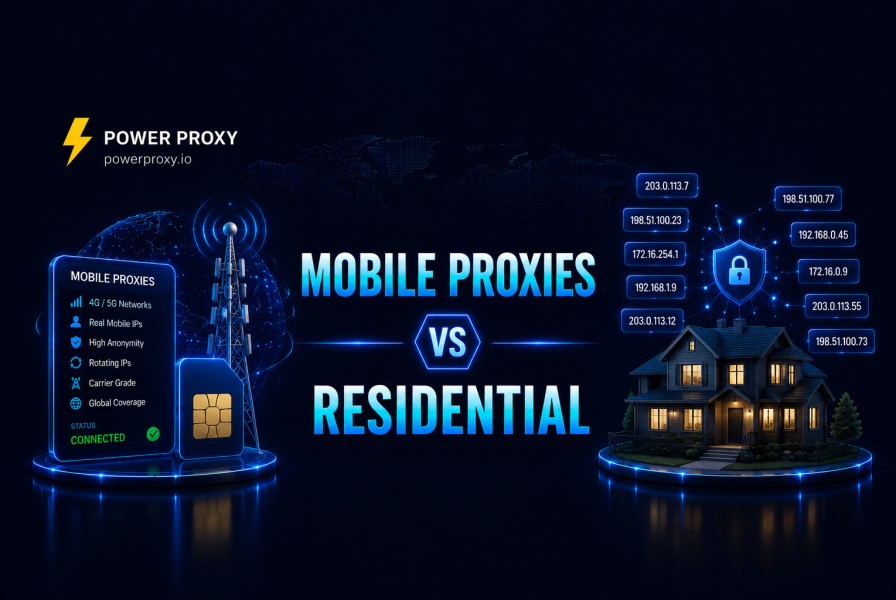
Residential proxies and mobile proxies both use real IP addresses. Both sit far above datacenter proxies on the trust scale. And both come up in the same conversations about web scraping, automation, and account management.
So when do you use one over the other?
The answer comes down to where the IP comes from, how websites evaluate that source, and what happens when detection systems push back. For most proxy use cases where performance actually matters, that answer points in one direction. This guide breaks down why.
What Is a Residential Proxy and How Does It Work?
A residential proxy routes your traffic through an IP address assigned by an internet service provider to a real household. The destination server sees what looks like a home broadband user: a cable or fiber connection at a residential address.
Because these IPs belong to real people on real networks, they carry significantly more trust than datacenter IPs. Detection systems that immediately flag commercial server ranges treat residential traffic as legitimate by default.
Residential proxy networks source their IPs through P2P arrangements: real users share their connection in exchange for app access or small rewards. This works at a basic level, but it introduces a quality problem that compounds over time, which we will cover below.
What Is a Mobile Proxy and How Does It Work?
A mobile proxy routes traffic through a physical device connected to a cellular carrier network: a real SIM card in a modem or phone, operating on 4G or 5G. The IP the target site sees is assigned by a telecom operator like Vodafone, T-Mobile, or AT&T.
The key difference from residential proxies is infrastructure ownership. A dedicated mobile proxy provider owns the hardware outright: real modems, real SIM cards, real carrier subscriptions. There is no borrowed bandwidth from third-party users.
Mobile carrier networks also use CGNAT (Carrier-Grade NAT), which places thousands of real subscribers behind a single shared public IP simultaneously. Blocking that IP means blocking all of them. Platforms simply cannot do that at scale, which is why mobile IPs carry a structural trust advantage that no other proxy type matches.
Residential Proxy vs Mobile Proxy: Key Differences
| Residential Proxy | Mobile Proxy ▲ | |
|---|---|---|
| IP Source | ISP home broadband | Cellular carrier (4G/5G) |
| Infrastructure | P2P / third-party users | Owned hardware, dedicated devices |
| Trust Level | High | Highest (CGNAT advantage) |
| IP Pool Contamination | Common in shared pools | Minimal |
| Cost per GB | $2 – $8 | $5 – $15 |
| Coverage | 150+ countries | Major markets well covered |
| Best For | High-volume, low-protection targets | Social media, anti-bot, account mgmt |
Trust Level and Anti-Bot Detection Resistance
Both proxy types pass the basic check: neither looks like a datacenter. But detection systems in 2026 go much deeper than that. They score IPs based on ASN type, subnet reputation, and behavioral history before a single request lands.
This is where residential proxies have a structural problem that mobile proxies do not: IP pool contamination. When you rotate onto a residential IP, you inherit whatever reputation the previous users left on it. In busy shared pools, many IPs carry history from prior scraping or automation activity. You start with a reputation deficit you did not create.
Mobile IPs do not have this problem in the same way. The CGNAT pool is so large and so continuously shared by real users that individual IP reputation is far harder for platforms to build and act on. On heavily protected targets like Instagram or TikTok, the difference is not incremental. It is the difference between accounts that stay stable and accounts that spend their time in verification loops.
IP Rotation Behavior
Residential proxies rotate based on provider settings: per request, per session, or on a timer. The rotation is controlled and artificial.
Mobile proxies rotate when the device disconnects and reconnects to the carrier: a modem reset, a tower handoff, or a carrier-level routing shift triggers a new CGNAT assignment. The rotation pattern matches what real phones do naturally, which makes it far harder to fingerprint than a predictable provider-controlled schedule.
Speed, Latency, and Performance
Residential proxies run on home broadband: fiber and cable connections that are stable and fast under most conditions.
Mobile proxies depend on cellular networks, which can introduce more variability than fixed broadband. In practice, 5G infrastructure has narrowed this gap considerably, and for the vast majority of proxy use cases, including scraping, account management, and automation, the latency difference has no meaningful impact on performance.
Geographic Coverage
Residential proxy pools cover more countries and cities simply because home internet connections exist almost everywhere. Major providers offer IPs in 150 to 195 countries with city-level targeting.
Mobile proxy coverage is more concentrated, tied to where providers have deployed physical modem infrastructure. All major markets are well covered. For the small subset of operations that require granular targeting in niche or less common regions, residential proxies offer more options.
Cost
Residential proxies range from around $2 to $8 per GB depending on volume. Bulk tiers bring the cost down significantly, while pay-as-you-go plans sit at the higher end of that range.
Mobile proxies typically run $5 to $15 per GB, reflecting the hardware and carrier data costs behind the infrastructure.
The per-GB comparison is not the whole story. On heavily protected targets, residential proxies waste a significant portion of bandwidth on failed requests and blocked responses. Mobile proxies waste far less. When you factor in actual successful outcomes, the cost difference narrows considerably and, for high-stakes targets, often reverses.
When to Use Residential Proxies
Residential proxies make sense for a specific set of use cases: targets that do not employ advanced anti-bot protection, where volume is high and cost sensitivity is the primary constraint.
SEO monitoring, price tracking on standard e-commerce sites, and general web scraping from public-facing pages with minimal protection are reasonable fits. For these high-volume, low-risk tasks, the lower per-GB cost is a genuine advantage.
But this is a narrower category than it might seem. Most platforms worth scraping at scale in 2026 have some level of bot protection. And every time a residential IP gets blocked, that cost gets added back in.
When to Use Mobile Proxies Instead
Mobile proxies are the right choice for any operation where success rate matters more than headline cost per GB.
Social media management is the clearest case. Instagram, TikTok, Facebook, and LinkedIn run detection systems that evaluate session behavior, device signals, and network type together. Getting through one check is not enough. Mobile carrier IPs pass these evaluations more reliably because they match what real users on those platforms actually look like. Residential IPs, even clean ones, increasingly fail the behavioral and network-type checks that modern platforms run.
The same applies to e-commerce, ad verification, and any platform running Cloudflare, DataDome, or similar systems. When block rates on residential proxies start eating into your operation, switching is not an upgrade. It is a fix.
For multi-account work specifically, mobile proxies are in a different category entirely. Each session runs on a dedicated carrier IP with its own rotation behavior. There is no inherited reputation, no shared history, and no pool contamination carrying over from the previous user.
Can You Use Both Proxy Types?
Some operations use both proxy types. Residential proxies handle bulk collection on unprotected targets where cost is the main concern. Mobile proxies handle everything where reliability matters.
For most businesses running serious automation in 2026, mobile proxies cover the majority of the actual work. Residential proxies fill in the gaps on the lowest-stakes tasks.
Residential vs Mobile Proxy: Which One Is Right for You?
The decision comes down to one question: what does a failure actually cost you?
If your targets are unprotected and volume is everything, residential proxies work. But most operations that matter in 2026 run against platforms that have real bot protection. For those, mobile proxies are not a premium option. They are the baseline for consistent performance.
The per-GB cost is higher. The cost of blocked requests, burned accounts, and rebuilt pipelines is higher still.
Stop Losing Requests to Blocked IPs
Power Proxy offers dedicated 4G/5G mobile proxies on Vodafone's network, with full IP rotation control, HTTP/SOCKS5/OpenVPN support, and a dedicated device per connection. No shared bandwidth, no inherited reputation.
Narmin Kamilsoy
Contributing author sharing insights and stories on our blog.